Shirley’s call for action, new legal developments and the People’s Inquiry’s evidence on risk, fairness and accountability. ͏ ͏ ͏ ͏ ͏ ͏ ͏ ͏ ͏ ͏ ͏ ͏ ͏ ͏ ͏ ͏ ͏ ͏ ͏ ͏ ͏ ͏ ͏ ͏ ͏ ͏ ͏ ͏ ͏ ͏ ͏ ͏ ͏ ͏ ͏ ͏ ͏ ͏ ͏ ͏ ͏ ͏ ͏ ͏ ͏ ͏ ͏ ͏ ͏ ͏ ͏ ͏ ͏ ͏ ͏ ͏ ͏ ͏ ͏ ͏ ͏ ͏ ͏ ͏ ͏ ͏ ͏ ͏ ͏ ͏ ͏ ͏ ͏ ͏ ͏ ͏ ͏ ͏ ͏ ͏ ͏ ͏ ͏ ͏ ͏ ͏ ͏ ͏ ͏ ͏ ͏ ͏ ͏ ͏ ͏ ͏ ͏ ͏ ͏ ͏ ͏ ͏ ͏ ͏ ͏ ͏ ͏ ͏ ͏ ͏ ͏ ͏ ͏ ͏ ͏ ͏ ͏ ͏ ͏ ͏ ͏ ͏ ͏ ͏ ͏ ͏ ͏ ͏ ͏ ͏ ͏ ͏ ͏ ͏ ͏ ͏ ͏ ͏ ͏ ͏ ͏ ͏ ͏ ͏ ͏ ͏ ͏ ͏ ͏ ͏ ͏ ͏ ͏ ͏ ͏ ͏ ͏ ͏ ͏ ͏ ͏ ͏ ͏ ͏ ͏ ͏ ͏ ͏ ͏ ͏ ͏ ͏ ͏ ͏ ͏ ͏ ͏ ͏ ͏ ͏ ͏ ͏ ͏ ͏ ͏ ͏ ͏ ͏ ͏ ͏ ͏ ͏ ͏ ͏ ͏ ͏ ͏ ͏ ͏ ͏ ͏ ͏ ͏ ͏ ͏ ͏ ͏ ͏ ͏ ͏ ͏ ͏ ͏ ͏ ͏ ͏ ͏ ͏ ͏ ͏ ͏ ͏ ͏ ͏ ͏ ͏ ͏ ͏ ͏ ͏ ͏ ͏ ͏ ͏ ͏ ͏ ͏ ͏ ͏ ͏ ͏ ͏ ͏ ͏ ͏ ͏ ͏ ͏ ͏ ͏ ͏ ͏ ͏ ͏ ͏

IPP ACTION BRIEFING ISSUE 03 3 NOVEMBER 2026

END IPP NOW: TURN THE PROMISE INTO FREEDOM, ACCOUNTABILITY AND REPAIR

WELCOME

Welcome to the third edition of the IPP Action Briefing.

This edition brings together important appeal developments, parliamentary scrutiny, determined campaigning and progress in the People’s Inquiry into IPP, Risk and State Harm.

It also asks a question that grows more urgent with every passing week: when will the Government’s promise to end IPP become a clear, enforceable route out of indefinite punishment? For people still imprisoned, those living under the threat of recall, and families who have spent years fighting for justice, uncertainty has consequences. Political announcements can restore hope. Without a credible timetable, practical protection and visible delivery, that hope can become another source of distress.

We begin with Shirley Debono’s demand for immediate action, followed by Adam J. Robinson’s examination of reform promises and the persistence of indefinite punishment. We explain how our recent public briefing connects initial evidence with the Inquiry’s developing investigation, before setting out the month’s media, legal and political developments.

We also report a new researcher appointment, continuing November recruitment, and the progress of our National Lived Experience and Survivors Council, where four positions have now been filled. Thank you to everyone who has donated, subscribed, shared our work or offered their expertise. Your support is helping us build an independent investigation capable of establishing the truth, challenging State power and turning evidence into proposals for accountability, reparation and lasting change.

Shirley Debono
Founder, IPP Committee in Action
Co-Founder, Executive Director and Head of Communications, The People’s Inquiry into IPP, Risk and State Harm

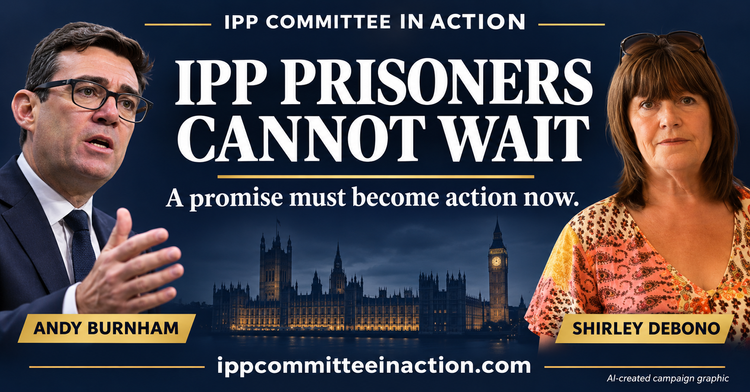
ANDY BURNHAM: IPP PRISONERS CANNOT WAIT UNTIL THE END OF PARLIAMENT

Shirley’s latest blog welcomes the Government’s commitment to end IPP and asks why people who have already lost so much of their lives should face further years of uncertainty. The public commitment was announced on 30 August 2026. Justice Secretary Alex Norris set it out in the House of Commons on 1 September, and on 15 September anticipated a further announcement later this year.

Those commitments matter. Families and campaigners fought for years to secure recognition that the remaining sentence must end. Yet recognition must now produce a published legislative route, an urgent timetable and immediate measures to protect people while that work proceeds. Shirley’s question is direct: why should somebody already years beyond their minimum tariff be expected to organise their survival around the end of another Parliament?

Shirley’s blog calls for urgent individual reviews of continued detention; proper scrutiny of recalled prisoners, particularly where there is no new conviction; effective mental-health care; timely and fair parole; and a clear reintegration framework that does not leave people moving repeatedly between fragile freedom and indefinite custody. These demands address the present danger as well as the eventual legislation. People need support, fair decisions and practical opportunities to rebuild their lives now.

THE UNITED NATIONS FINDINGS REQUIRE A PRACTICAL RESPONSE

Shirley also returns to the complaint pursued through IPP Committee in Action with legal assistance from Alun Jones KC and Dr Muin Boase. UN Working Group on Arbitrary Detention Opinion No. 16/2026, published on 23 July 2026, found the deprivation of liberty of the five named individuals arbitrary under international human-rights law. Those findings require a substantive response. The Government must explain what steps it will take to address the violations and the circumstances identified. The Opinion does not itself cancel domestic sentences or automatically release everyone subject to IPP. Its significance lies in the findings it makes and the responsibility to provide an effective answer. Shirley remembers Joshua McRae, who died in 2024 and was one of the five people named in the UN proceedings. His life, his family’s loss and the unanswered questions surrounding his death must remain part of the public record.

HABEAS CORPUS: THE NEXT HEARING

Shirley’s latest update reports that the habeas corpus applications concerning Leroy Douglas, Wayne Williams, Shaun Anton Lloyd and Abdullahi Suleman are listed for 25 November 2026 in Cardiff. The legal team describes High Court proceedings challenging the lawfulness of continued detention. The hearing date is reported here from Shirley’s update; readers should check subsequent announcements for confirmed attendance arrangements. Shaun is Shirley’s son. For her family, as for thousands of others, the question is whether years of separation and uncertainty can finally give way to a sustainable life together.

A promise to end IPP must bring action now. People’s lives cannot be left suspended between an announcement and its eventual fulfilment.

READ SHIRLEY’S BLOG

READ THE LEGAL TEAM’S EXPLANATION

READ THE GOVERNMENT’S ANNOUNCEMENT

READ THE COMMONS STATEMENT OF 1 SEPTEMBER

FROM ADAM J. ROBINSON

Adam J. Robinson, BA (Hons), PGCert, MA
Co-Founder, Chair and Lead Researcher, The People’s Inquiry into IPP, Risk and State Harm
Founder, Exemplar Group

IPP REFORM PROMISES AND THE PERSISTENCE OF INDEFINITE PUNISHMENT

Adam’s new polemic examines the distance between compassionate political language and the legal machinery that continues to govern people’s liberty.

Its central question is exacting:

What has actually changed in the State’s power over the person?

Release, shorter licence periods and successful terminations matter. They restore opportunities, reunite families and must be recognised. Yet improvements within an indefinite sentence cannot settle the position of everybody who remains subject to it. The article traces successive legislative changes, action plans and operational initiatives. It asks why measures intended to improve progression through IPP have repeatedly taken precedence over removing its indefinite foundation.

It also examines the unequal distribution of responsibility. People serving IPP must demonstrate compliance, insight and progress. Institutions promise to review, consider and monitor. An individual’s alleged failure can have immediate consequences for liberty; institutional delay or an inaccurate record can be much harder to challenge effectively. That imbalance becomes especially serious when OASys assessments, psychological reports, recall documents and parole dossiers repeat a disputed allegation. Several documents may appear to corroborate a claim while depending on the same original source. The number of repetitions can grow without the underlying evidence becoming stronger.

The Inquiry will examine where descriptions originate, what supports them, whether uncertainty and contrary evidence survive, and whether corrections reach every organisation relying on the earlier account. The article connects these questions with the human consequences of indefinite punishment: deteriorating wellbeing, damaged relationships, lost livelihoods, interrupted recovery and the fear that a life rebuilt in the community can be dismantled through recall. It also confronts the responsibilities carried by political communication. An announcement can change somebody’s expectations overnight. It cannot, by itself, change the legal authority under which that person remains detained or liable to recall.

For IPP prisoners, families and campaigners, growing frustration concerns this continuing gap between recognition and resolution. The conclusion reaches beyond better administration. Ending the sentence must be accompanied by independent scrutiny, effective remedies, funded reintegration and accountability for avoidable harm.

Justice requires institutions to answer for their own decisions with the same seriousness they demand from the people subject to their power.

WATCH THE ARTICLE TRAILER ON YOUTUBE

EXPLORE EXEMPLAR’S ACADEMIC INSIGHTS

READ THE ARTICLE ON LINKEDIN

OUR PUBLIC BRIEFING 01: EVIDENCE, POWER AND THE DEMAND FOR ACCOUNTABILITY

Our Public Briefing 01, dated 26 October 2026, brings the People’s Inquiry’s initial work into focus. It examines the relationship between risk assessments, procedural fairness and institutional harm, connecting published records with evidence being submitted by people affected by IPP. Its central concern is whether a system that demands accountability from individuals provides an equally effective means of holding its own institutions accountable for the information they produce, the decisions they make and the harm they may cause.

Government interventions have helped some people secure release or licence termination, and those achievements matter. Yet existing IPP sentences remain in force, while the Inquiry is receiving accounts of disputed records, escalating allegations, ineffective routes of challenge and safeguards reportedly absent when they were needed most. These concerns require investigation beyond the question of administrative delay. They concern the reliability of evidence used to restrict liberty, the practical ability to contest it and the consequences when an institution’s account of a person becomes difficult to challenge.

We distinguish throughout between findings established in published records and accounts that remain under investigation. Receiving evidence of a reported practice does not establish its national prevalence, its cause or the responsibility of a particular individual. Our task is to examine original documents, preserve contrary evidence, seek institutional responses and establish what the available material can support.

WHEN REPETITION BECOMES AUTHORITY

OASys assessments, prison and probation reports, psychological evaluations, recall papers and parole decisions can carry descriptions from one stage of a person’s sentence into the next. Several documents may appear to corroborate an allegation while relying on the same original source. Repetition can give a claim institutional authority without adding independent evidence, particularly where its disputed status or the person’s response disappears along the way.

One account submitted to the Inquiry contrasts an earlier description of a person with his hood up with a later licence-termination refusal describing entry into a shop wearing a balaclava. That difference could materially alter how conduct is understood, suggesting disguise or preparation beyond what the earlier wording establishes. We are examining the original records, whether additional evidence explains the change, how the description travelled and whether it influenced the decision. The question is evidential: what justifies the more serious account?

The same scrutiny must apply to the treatment of objections. People describe difficulty securing consequential corrections before disputed information influences another assessment or decision. Some also report that challenging an account has itself been interpreted adversely, including through descriptions such as “grievance thinking”. This raises a fundamental question for procedural fairness: can a person contest the evidence used against them without the act of contesting it becoming further evidence against them?

SAFEGUARDS MUST WORK BEFORE THE DECISION

Formal rights matter only if people can exercise them effectively. The briefing examines accounts of licence-termination reports allegedly not being discussed or disclosed before submission, and named solicitors reportedly not receiving the material needed to make representations. The supervision framework described in the briefing provides for discussion, disclosure of the final report and seven calendar days for representations, with referral ordinarily awaiting those representations or expiry of that period.

These protections create an opportunity to identify inaccuracies, supply missing information and answer adverse claims before a consequential decision is made. If that opportunity is lost, later explanations may offer little comfort to someone whose liberty remains restricted. Naming a solicitor should prompt a clear check that representation has been arranged and that the relevant material has reached them.

Alongside the accounts under investigation stands a published delivery failure. HMPPS reported that only 20% of IPP termination reports met their deadline against a target of 97.5%, during the reporting period from 17 July 2025 to 31 March 2026. Some late reports delayed referrals; the figures do not establish that every late report did so. They nevertheless expose a substantial gap between the promised safeguard and its delivery. A procedure cannot protect someone retrospectively from a decision made without their effective participation.

STAFF SUFFERING AND THE COST OF SILENCE

The Inquiry is also receiving accounts of serious distress among staff affected by IPP policy, including the experience of witnessing deterioration, self-harm, deaths and suffering they feel unable to prevent. Some describe fear that speaking openly could damage their employment or careers. We are investigating the severity, causes and consequences of these reported experiences, including their effects on health, relationships and family life.

Staff evidence can illuminate both the treatment of people subjected to the sentence and the pressures experienced by those required to administer it. Former employees may have greater practical freedom to speak than people still working within an institution. That difference must inform how we interpret the available record: silence cannot safely be treated as evidence of agreement, confidence or wellbeing. Safe routes for participation are therefore essential to an investigation capable of hearing what ordinary reporting channels may miss.

RELEASE ADVOCACY AND SCRUTINY OF HARM

The briefing also raises difficult questions about the relationship between legal strategy, progression requirements and serious psychological deterioration. Seeking the quickest available route to release can be essential. Alongside that work, there must remain room to examine whether repeated assessments, disputed information, delay or unmet clinical needs are contributing to harm, and whether the process itself requires legal challenge.

Article 3 of the European Convention on Human Rights prohibits torture and inhuman or degrading treatment. Whether particular treatment crosses that threshold requires careful examination of its severity, duration, effects and the person’s vulnerability. The Inquiry has made no blanket finding that solicitors knowingly facilitate torture. We are investigating whether credible concerns about deterioration receive adequate legal and clinical attention, and whether advocacy for release is accompanied by effective scrutiny of potentially harmful processes.

ACCOUNTABILITY MUST REACH THOSE WHO EXERCISE POWER

In his report to President Truman on 7 June 1945, helping establish the foundations of the Nuremberg prosecutions, Robert H. Jackson wrote:

“We do not accept the paradox that legal responsibility should be the least where power is the greatest.”

Jackson’s statement arose from the prosecution of Nazi crimes. Its relevance here is the principle that authority must remain answerable to law; it does not establish a historical equivalence or determine criminal responsibility in IPP cases. It challenges an enduring danger: that responsibility becomes harder to locate as the power exercised becomes greater.

For this Inquiry, accountability requires tracing decisions through the record. Who produced the information? Who checked it? Who relied upon it? What warnings were received, what action followed and what opportunity existed to prevent further harm? Responsibility must be established through evidence and fair process, including a meaningful opportunity to answer substantial criticism. It must also reach the organisational and political levels at which rules, resources and priorities were determined.

Coroners’ findings provide an essential line of scrutiny. As the briefing notes in relation to Haydar Jefferies and Matthew Price, published findings already demonstrate why institutional responsibility requires examination. Our wider work will investigate identifiable IPP and DPP deaths across custody, hospital and community settings, distinguishing a death occurring during the sentence from evidence that the sentence or a particular failure contributed to it. We will examine whether warnings reached those able to act and whether accepted recommendations produced demonstrable changes.

FINDINGS TO REMEDY

The associated campaign seeks complete retrospective abolition of IPP and DPP, independent judicial scrutiny of continuing restrictions and properly funded support. The Inquiry’s research must establish its findings independently, including where the evidence challenges campaign assumptions. Immediate priorities identified in the briefing include effective correction of consequential errors, timely disclosure and representation, independent scrutiny of reported procedural failures, safe routes for staff evidence and investigation of serious deterioration and deaths.

The National Lived Experience and Survivors Council will help shape the Inquiry’s priorities, scrutinise emerging interpretations and challenge its leadership. Victims of crime, survivors, people affected by IPP and families must have meaningful influence while retaining their distinct experiences and perspectives. Accountability must govern our own work as well as the institutions we examine.

The State must be able to demonstrate the accuracy of the evidence it uses, the fairness of its procedures and the effectiveness of its safeguards. Recognition of injustice must lead to decisions that can be challenged, errors that can be corrected, warnings that produce action and remedies that address the harm established. People’s freedom and survival cannot depend on accepting an account of themselves they cannot effectively challenge. Nor can institutional authority place those responsible for that account beyond scrutiny.

EXPLORE THE PEOPLE’S INQUIRY

THE PEOPLE’S INQUIRY WARNS: DELAY AND SHATTERED HOPE MAY INCREASE SUICIDE RISK

The People’s Inquiry is increasingly concerned that a promise of abolition without a clear route to delivery may intensify hopelessness and suicide risk among particularly vulnerable people serving IPP. This concern must be understood alongside the documented consequences of the previous rejection of resentencing. On 28 September 2022, the Justice Committee published its report recommending legislation enabling a resentencing exercise. The Government’s response and covering letter were received by the Committee on 1 February 2023 and published on 9 February 2023. The Government rejected the central resentencing recommendation, citing public-protection concerns.

On 12 May 2023, Independent Monitoring Boards reported increased hopelessness and frustration across evidence from 24 prisons. They also reported three apparently self-inflicted IPP deaths in the four weeks following the announcement. That record demands serious attention. It does not establish a single cause for each death. Nor has the Inquiry established a measured increase in suicides caused by the present Government’s announcement. It establishes a warning that ministers and public services cannot responsibly disregard: political decisions and the destruction of anticipated hope can have grave consequences for people already living with profound vulnerability.

The current promise must therefore be accompanied by honest communication, an urgent timetable and practical protection. People need to know what has been agreed, what remains unresolved, who is responsible and when the next decision will be made. Prison, hospital and probation services must recognise the effects that announcements, delays and disappointment can have on individuals. Access to care and support must be effective throughout that period. There are grounds for determined action: successful appeals, international findings, sustained campaigning and the Government’s acknowledgement that IPP must end. Each development matters. None justifies promising an individual a release date or outcome that has not been secured.

Hope must be supported by action that people can see and rely upon.

READ THE GOVERNMENT’S 2023 RESPONSE

READ THE INDEPENDENT MONITORING BOARDS’ WARNING

Shaun Lloyd with his mother Shirley Debono. Photograph supplied to The Independent and published with its June 2026 reporting.

SHAUN LLOYD: A SON AND FATHER ON HIS FIFTH IPP RECALL

Shaun Lloyd, son of veteran campaigner Shirley Debono, is pursuing two distinct legal routes concerning the continuing consequences of his sentence. The CCRC records a robbery conviction at Cardiff Crown Court in December 2005, a 33-month minimum term and an age of 18 at sentencing. His sentence was referred in September 2026, following consideration of whether sufficient weight had been given to youth and immaturity when assessing future dangerousness.

Shaun’s fifth recall was reported in June. His family disputed the allegation behind the police contact and described the disruption to his children, family life and railway apprenticeship. Those accounts require scrutiny of the contemporaneous evidence and the reasons for recall. The Ministry of Justice’s published position is that recall is an essential public-protection measure and that IPP recall decisions have additional safeguards. Shaun is also one of the four applicants in the High Court habeas corpus proceedings following the UN Opinion. Shirley’s latest update gives 25 November 2026 in Cardiff as the hearing date.

A CCRC referral concerns the sentence through an appeal route. Habeas corpus challenges the lawfulness of detention. Each offers a distinct form of scrutiny; neither should be reported as a successful outcome before the court decides it. Shaun’s case brings the wider issues into focus: recognition of youth and development, fair assessment of current circumstances, proportionality in recall, and the ability to sustain employment and family relationships.

Behind the legal documents is a person whose future, and whose children’s experience of family life, must remain visible.

READ SHAUN’S CCRC CASE RECORD

READ THE REPORT ON HIS FIFTH RECALL

IPP DEVELOPMENTS: THE DATED CHRONOLOGY

The following chronology brings together developments located from 4 October to 2 November 2026, the research cut-off for this edition. Event dates and publication dates are distinguished, and follow-up coverage is identified to avoid counting the same appeal or referral twice.

4 OCTOBER — FAMILY LIFE AND THE SEARCH FOR A SOLUTION

The Independent reported Rachel’s reunion with her son, highlighting the consequences an IPP recall can have for parenting and family life.

READ THE REPORT

In separate commentary, Howard League Chief Executive Andrea Coomber described serious work by officials on ending IPP while acknowledging that the mechanism and timetable remained unknown.

READ ANDREA’S ARTICLE

5 OCTOBER — WILLIAM CLARK AND FAILURES IN SUPPORT

Inside Time reported on William Clark, who died at Wormwood Scrubs in December 2024. The Ombudsman’s investigation raised concerns about medication controls, emergency response and arrangements for supporting IPP prisoners.

The official case record classifies the death as other non-natural. The October reporting followed publication of the investigation on 25 September 2026.

READ THE COVERAGE

READ THE PPO RECORD AND REPORT

6 OCTOBER — PRESSURE FOR A TIMETABLE

Inside Time brought together planned legal, parliamentary and public campaigning. It also reported the Justice Secretary’s conference commitment to act, with continuing questions about the legislative route.

READ THE ROUND-UP

7 OCTOBER — THREE INDETERMINATE SENTENCES REPLACED

Appeals at Wolverhampton Crown Court resulted in replacement sentences for Luke Ings, Liam Bennett and James Ward.

Reporting described Ings and Bennett as entitled to release without further supervision, and Ward’s continuing supervision as ended. These were three sentence outcomes following earlier CCRC referrals.

READ THE ACCOUNT OF THE HEARING

8 OCTOBER — FOLLOW-UP ON LUKE INGS AND LIAM BENNETT

The Independent examined the two men’s long detention following offending in adolescence and the importance of youth, maturity and assessments of future dangerousness.

READ THE FOLLOW-UP

9 OCTOBER — APPEAL DETAILS AND “DO THEY HAVE A PLAN?”

The Justice Gap reported replacement sentences of four years and 264 days for Bennett, 42 months with a 30-month extended licence for Ings, and two years for Ward. Time already served meant the outcomes ended continuing custody or supervision under the previous sentences.

READ THE APPEAL DETAILS

Trapped: The IPP Prisoner Scandal released Do They Have a Plan?, examining the abolition pledge, international scrutiny and the continuing search for a deliverable solution.

LISTEN TO THE EPISODE

Viv Ahmun’s Burnham’s Prison Trap connected IPP with prison-capacity policy, political responsibility and consequences for families and Black communities.

READ THE COMMENTARY

11–25 OCTOBER — SEEING LIFE: WOUNDED SOULS

Chester Cathedral hosted an exhibition of poetry and art curated by former prison chaplain Revd Dr David Kirk Beedon from his doctoral research. His introductory talk followed Evensong on 11 October at 4pm.

The exhibition brought the experiences of men serving IPP into public view.

READ THE EVENT RECORD

12 OCTOBER — APPEAL REPORTING AND POLITICAL PRESSURE

Inside Time reported the three replacement sentences arising from the 7 October hearing. Labour Home also reported Kim Johnson MP’s renewed call for action.

READ THE APPEAL REPORT

READ THE POLITICAL UPDATE

13 OCTOBER — INDIVIDUAL APPEALS AND FAMILY SUPPORT

Raymond Smith’s Justice Gap commentary examined the CCRC’s developing work and the need for a remedy extending across the remaining population. Its discussion of September referrals was not a new October batch.

READ THE ANALYSIS

HMPPS also published HMP Stocken’s family strategy, including a family-day initiative for IPP and long-serving prisoners.

READ THE STRATEGY

20 OCTOBER — JUSTICE COMMITTEE SCRUTINY AND FAMILY REPRESENTATION

The Justice Committee questioned Chief Inspector of Prisons Charlie Taylor about the abolition pledge, release preparation, recalled prisoners and access to required courses. Questions 65–71 address IPP directly.

READ THE OFFICIAL EVIDENCE

An UNGRIPP information event was advertised for 5–7pm in Room T, Portcullis House, hosted by Bambos Charalambous MP, with talks from 6pm. The CCRC’s subsequent announcement records Dame Vera Baird meeting UNGRIPP families in Parliament.

READ THE EVENT NOTICE

21 OCTOBER — STACEY CLOUGH AND INJUSTICE OF IPP TAKE THE CAMPAIGN TO MANCHESTER

Stacey Clough and Injustice of IPP organised and led the protest outside Number 10 North, the Prime Minister’s Manchester office at Heron House, 47 Lloyd Street.

The demonstration was announced for 11am. Families demanded a timetable and proper support for people leaving custody, keeping public attention on the gap between the abolition pledge and its delivery.

We recognise Stacey’s leadership, Injustice of IPP’s organising work and the contribution of everyone who attended and supported the protest.

READ THE CAMPAIGN’S DEMANDS

22 OCTOBER — MANCHESTER PROTEST FILM

Church on Wheels: IPP prisoner injustice — “Let my people go” follows Bishop Mick Fleming and Pastor Clara White of Church on the Street to the Manchester demonstration.

Clara’s campaigning for her brother Thomas brings another family’s experience into the public record. The film conveys the determination of people demanding that a national promise produce meaningful change.

Thumbnail from the Church on Wheels film, published 22 October 2026, showing Bishop Mick Fleming and an Injustice of IPP banner.

WATCH AND SHARE THE FILM

FOLLOW INJUSTICE OF IPP

25–26 OCTOBER — ADAM’S POLEMIC AND ARTICLE TRAILER

IPP reform promises and the persistence of indefinite punishment examines the relationship between promised reform, continuing State power and the human consequences of delay.

The article is dated 25 October, with its LinkedIn publication and YouTube trailer appearing on 26 October.

WATCH THE TRAILER

28 OCTOBER — GOVERNMENT ASKED WHEN LEGISLATION WILL ARRIVE

Nick Timothy MP tabled written question 38974, asking about progress on legislation to end IPP and when it would be introduced. At the research cut-off, the public record showed it due for answer on 2 November, without a published answer.

READ THE QUESTION

The petition Resentence IPP prisoners; end indefinite licence and limit recall closed with 347 signatures. It did not reach the 10,000-signature threshold for a government response.

READ THE PETITION RECORD

29 OCTOBER — UPDATED OFFICIAL POPULATION AND SAFETY RECORDS

The Ministry of Justice published a custody snapshot for 30 September 2026 recording:

  • 832 IPP prisoners who had never been released;

  • 1,403 IPP prisoners detained following recall;

  • 2,235 IPP prisoners in total.

These figures update the June snapshot of 2,271 for current population reporting.

READ THE OFFICIAL STATISTICS

The same publication day brought updated safety-in-custody, community-death and proven-reoffending statistics. Their reporting periods and populations differ and must be identified whenever figures are used.

SAFETY IN CUSTODY

DEATHS UNDER COMMUNITY SUPERVISION

PROVEN REOFFENDING

HMPPS’s annual performance report also described continuing action-plan work and changes to licence-termination eligibility.

READ THE PERFORMANCE REPORT

30 OCTOBER — RECALL AND FAMILY JUSTICE

The Transparency Project’s October reporting round-up included the IPP family case covered earlier in this chronology, keeping the consequences of recall within the wider family-justice debate.

READ THE ROUND-UP

31 OCTOBER — INQUIRY LEGAL RECRUITMENT

The People’s Inquiry released its advert for a junior solicitor or legal professional in an unpaid role, supporting participant rights and the ethical conduct of interviews.

WATCH AND SHARE THE ADVERT

2 NOVEMBER — SEVEN NEW CCRC REFERRALS AND CARL LAMB’S STORY

The CCRC announced seven further referrals, bringing its 2026 total to 32, with more than 250 cases under review. All seven people remained in custody when the referrals were announced.

The Independent reported the same development. Its coverage concerns these seven cases and must not be counted as an additional batch.

READ THE CCRC ANNOUNCEMENT

READ THE INDEPENDENT’S COVERAGE

The latest Trapped episode, Permanent Torture, hears from Carl Lamb’s father Graham Eggar and brother Danny Eggar. It examines lost years and family distress alongside proposals for mental-health care, housing and support after release. Carl’s September referral is an existing case, separate from the seven announced on 2 November.

LISTEN TO CARL’S STORY

Richard Garside, Director of the Centre for Crime and Justice Studies, also examined the deeper changes needed to resolve IPP and other forms of indeterminate punishment.

READ THE CCJS BULLETIN

THE CCRC REFERRALS: NAMES, NUMBERS AND THEIR SIGNIFICANCE

THE SEVEN CASES ANNOUNCED ON 2 NOVEMBER

PersonAge at sentencingMinimum term reported by the CCRCMichael Seddon237 years 6 monthsAndre Hurst204 yearsGemma Smith1922½ monthsScott Hulme181 year 243 daysJoshua Gordon234 yearsDavid Hill214 years 6 monthsRyan Helstern1727 months

A referral means the Commission considers there is a real possibility that the sentence would not be upheld. The appeal court determines the outcome. Referral does not itself mean release or that the conviction has been quashed.

ALL 32 CCRC REFERRALS ANNOUNCED DURING 2026

27 January 2026 — 5 referrals

  • Benjamin Hibbert

  • Stuart O’Neill

  • Jay Davis

  • Luke Ings

  • James Ward

24 April 2026 — 1 referral

  • Liam Bennett

5 May 2026 — 1 referral

  • Daniel Grace

29 June 2026 — 2 referrals

  • Christopher Brown

  • Jamie Jackson

14 July 2026 — 2 referrals

  • Dean Mullins

  • Sheldon Coore

4 August 2026 — 3 referrals

  • Richard Lloyd

  • Christian Chambers

  • Marlon Chen

14 August 2026 — 2 referrals

  • Simeon Gamage

  • Harry Bees

24 September 2026 — 9 referrals

  • Abdiwali Hassan

  • Carl Lamb

  • Ben Nye

  • Scott Prince

  • Liam Osborne

  • Jerome Barrett

  • Ms AD

  • Shaun Lloyd

  • Jason Ritchie

2 November 2026 — 7 referrals

  • Michael Seddon

  • Andre Hurst

  • Gemma Smith

  • Scott Hulme

  • Joshua Gordon

  • David Hill

  • Ryan Helstern

TOTAL: 32 announced referrals during 2026.

A CCRC referral sends a case to an appeal court for determination. It does not itself mean that the person has been released or that their conviction has been quashed. Ms AD is identified in the anonymised form used by the Commission.

These are 32 announced referrals, rather than 32 confirmed releases. Ms AD is identified in the anonymised form used by the Commission. Every successful appeal matters. For the individual and their family, it can change everything. Yet these routes depend on identifying grounds capable of succeeding in a particular case. They cannot resolve the position of everybody who remains subject to IPP. The CCRC is an independent review body carrying out its statutory responsibilities. The responsibility for the missing population-wide remedy remains with government and Parliament.

People should not have to depend on finding an exceptional exit from a sentence that Parliament has already stopped imposing. Individual correction must be accompanied by complete legislative resolution.

THE PEOPLE’S INQUIRY: BUILDING THE CAPACITY TO INVESTIGATE

The People’s Inquiry into IPP, Risk and State Harm is an independent civil-society investigation into how the sentence was created, how its power continues to operate, what harm and protection the evidence reveals, and what must change. We will connect interviews with people affected by IPP, families and staff to lawfully obtained OASys assessments, psychological reports, prison and probation records, recall papers, parole decisions and oversight evidence.

The investigation must examine good practice, protective relationships, successful support and evidence that challenges our initial interpretations. Institutions must have a meaningful opportunity to answer substantial criticism. Our commitment to challenging State power requires methods strong enough to withstand challenge themselves.

A NEW PSYCHOLOGY AND HUMAN DEVELOPMENT RESEARCHER

We have successfully interviewed and recruited a capable Psychology and Human Development Inquiry Researcher, a PhD student specialising in borderline personality disorder. This strengthens our capacity to examine psychological evidence, human development, trauma and institutional interpretation. The researcher’s contribution will include supervised analysis of reports and records, with careful attention to how personality-disorder labels, distress and behaviour are described and used in consequential decisions. Their appointment brings research expertise to this work. Clinical conclusions about individuals require an appropriate evidential and professional basis.

STRONG INTEREST AND CONTINUING NOVEMBER INTERVIEWS

We are receiving strong interest in the Inquiry’s vacant roles and will continue interviews throughout November.

The Inquiry Secretary role remains open. We need an organised person to help coordinate meetings, maintain secure administrative records, track actions and support clear communication.

Researcher vacancies remain in:

  • Law and Human Rights;

  • Neuroscience, Biology and Human Development;

  • AI, Technology and Justice Futures;

  • Criminology, Penology and Social Harm.

These strands will work together within a supervised research programme. Current opportunities are voluntary. Funding is being explored, and future paid work cannot be promised at this stage.

To express interest, send a short introduction, relevant experience or CV, and your availability to exemplarvision@icloud.com.

JUNIOR SOLICITOR OR LEGAL PROFESSIONAL WANTED

We have also released an advert for a junior solicitor or legal professional to support the Inquiry in an unpaid role. The successful applicant will help protect participant rights across Inquiry interviews, supporting accessible information, informed and continuing consent, confidentiality, withdrawal arrangements and safeguarding. They will help the team identify when specialist legal advice is required and maintain clear boundaries between research participation, public identification and media consent. The role offers experience alongside people who have lived under IPP and an experienced criminal-justice civil-society team. Professional legal work must remain within the applicant’s competence and appropriate supervision and regulatory arrangements.

Please share the advert with legal networks, universities and people whose experience could strengthen this work.

WATCH AND SHARE THE LEGAL RECRUITMENT ADVERT

Contact: exemplarvision@icloud.com

THE NATIONAL LIVED EXPERIENCE AND SURVIVORS COUNCIL

FOUR POSITIONS FILLED — AND REAL INFLUENCE TAKING SHAPE

The Council is progressing well since its inception. Under the effective leadership of our National Lived Experience and Survivors Council Lead, four positions have now been filled.

Its purpose is to give people harmed by crime, people affected by IPP and families meaningful influence over the Inquiry’s questions, priorities, interpretation and proposals. Members will inform the Inquiry, hold its leadership to account and help shape its evolution. They will identify missing voices, question assumptions, preserve disagreement and examine whether proposed remedies answer the needs people have actually described.

The research team remains responsible for establishing findings through rigorous methods. The Inquiry must respond to substantive Council recommendations with decisions and reasons. This relationship gives participation practical authority: members can challenge the work, including the founders’ interpretations, and expect an answer.

THE IDEAS BEHIND THE COUNCIL

Donna Mertens’s transformative research paradigm asks who has the authority to shape knowledge and whose needs research serves. Applied here, people directly affected must help frame questions and examine interpretations throughout the work.

Zemiology, associated with scholars including Paddy Hillyard and Steve Tombs, asks what harm official legal categories overlook. Lost years of parenting, household debt, damaged health, interrupted education, stigma and distress carried by children can disappear when the record counts only custody, release and recall. Michel Foucault’s work on power directs attention to everyday institutional practices: observation, files, categories, assessments and professional judgements. The Council will help ask how a description acquires authority, how it can be challenged and what consequences follow. The same scrutiny must apply to power within our own Inquiry.

Transformative justice, including work developed by generationFIVE, asks what survivors need for safety and agency, what accountability requires, which conditions enabled harm and what would prevent repetition. Kenneth Gergen’s future-forming approach adds a practical question: what better arrangements can this knowledge help people build?

The founding mandate also draws on Jungian ideas about identity and Daoist ideas about leadership without unnecessary force as reflective prompts. They encourage recognition of the person beyond an institutional label and restraint in how people are invited to contribute. They are not diagnoses, required beliefs or proven trauma treatments. Together, these approaches connect participation with scrutiny and scrutiny with practical change. Their value must be demonstrated through the Council’s conduct and work.

HIDDEN HARMS, HEALING AND THE SURVIVOR VOICE

Survivors of crime must be able to define the safety, information, recognition, support and repair they need. Their experiences must not be borrowed to justify policies they did not help shape. People harmed through IPP must likewise be heard as people with knowledge, abilities, relationships and futures. These experiences remain distinct. Harm caused by crime, harm associated with State decisions and the loss carried by a bereaved family each require careful attention. No person’s suffering cancels another’s.

Trauma-informed participation means choice, understandable information, trust, practical support and respect for boundaries. Nobody must disclose private pain to earn a voice. No survivor is required to forgive, reconcile or meet somebody who harmed them. Council membership does not itself consent to research interviews or publication of a personal story. Healing cannot be guaranteed by a civic Inquiry. We can create conditions that respect it: being heard without appropriation, having errors examined fairly, seeing harm acknowledged, retaining control over participation and contributing to remedies that matter.

Lived experience and survivor knowledge can become public leadership. Supporting that possibility is central to the Council’s purpose.

SHAPING THE INTERCONTINENTAL YOUTH JUSTICE MANIFESTO

The Council will help shape the inception and development of the Inquiry’s Intercontinental Youth Justice Manifesto, informed by the evidence and, as the work develops, meaningful participation by young people and appropriate international partners.

IPP makes the youth question unavoidable. A sentence intended to address serious dangerousness was imposed more widely, including on children and young adults given short tariffs. Some are now approaching middle age while still living with decisions made during adolescence. Recognising this injustice must preserve the seriousness of the harm experienced by victims of the original offences. It must also prompt searching questions about how youth, adversity, immaturity and the capacity for change were understood.

Why did predictions made at a young age acquire such enduring authority? How did access to education, treatment, housing and representation affect outcomes? What did prolonged punishment do to the conditions later assessed as evidence of risk? The future manifesto will seek proposals for proportionate sentencing, fair review, survivor support, early intervention, reliable records, accountable technology and recovery after harm. Its international ambition must grow through reciprocal learning and participation. We cannot claim to represent young people or countries that have not contributed.

The Council’s potential is to help build a durable method through which affected people shape justice, institutions answer evidence and future generations receive stronger protection.

OUR SIX PRINCIPLES AS PUBLIC COMMITMENTS

TRUTH means establishing what happened and distinguishing verified facts, contested accounts and unanswered questions. It requires visible correction when our own account is wrong.

POWER means examining who made a rule or decision, whose evidence counted, who could challenge it and who bore its consequences. State authority, professional status and founder status must remain open to scrutiny.

ACCOUNTABILITY means tracing decisions and omissions, seeking records and reasons, hearing responses and publishing findings proportionate to the evidence. An accepted recommendation is not proof that practice changed.

REPARATION means pursuing recognition, remedy and practical repair. Depending on the evidence and applicable legal routes, this may include corrected records, rehabilitation, mental-health support, restored opportunities, restitution or compensation.

TRANSFORMATION means changing the practices and conditions that produced avoidable harm. People directly affected must influence what better arrangements should do and how their effects are assessed.

NON-RECURRENCE means specifying safeguards, responsible institutions and ways to check whether people are safer. The knowledge gained from IPP must protect future generations.

EXPLORE THE PEOPLE’S INQUIRY

IPP COMMITTEE IN ACTION: OUR POSITION

We campaign for the absolute and complete retrospective abolition of IPP and its DPP equivalents, ending every remaining sentence in custody and the community through legislation.

Release must lead to a sustainable future. It must not leave the same indefinite sentence waiting to reactivate through recall.

The transition must address demonstrable public-protection needs through reliable evidence, independent judicial decisions and proportionate arrangements. An old label cannot substitute for current assessment. Any replacement arrangements must avoid recreating indefinite punishment under another name.

We therefore call for:

  1. Urgent retrospective legislation with a published timetable, clear responsibility and independent scrutiny of delivery.

  2. Immediate, properly resourced review of continued detention, including recalled prisoners and people in hospital, with representation and meaningful opportunities to challenge evidence.

  3. Release wherever there is no lawful and necessary basis for continued confinement, with proportionate judicial safeguards for any exceptional arrangements legislation requires.

  4. An end to indefinite IPP licence and recall, supported by a fair and clearly bounded transition.

  5. Funded recovery and reintegration, including housing, healthcare, treatment, education, employment and support for families.

  6. Effective correction of records and procedural protection, so established facts, allegations and professional opinions remain distinguishable.

  7. Independent investigation of deaths and serious harm, with meaningful family participation and implementation of preventive measures.

  8. Reparation and guarantees of non-recurrence, shaped with survivors of crime, people affected by IPP, families and relevant expertise.

These campaign commitments do not require researchers, Council members or participants to endorse an unproven allegation or a predetermined finding. The Inquiry’s conclusions must remain answerable to evidence.

PROMISE TO FREEDOM — HARM TO TRANSFORMATION

The developments in this edition reveal the possibilities and limits of the present moment. Appeals can correct individual sentences. International findings can expose violations. Protest can force a neglected issue into public view. Research can identify failures and clarify what must change. Parliament must now perform its own task: ending the sentence for everyone who remains subject to it.

Shirley’s blog, Adam’s polemic and the public briefing converge on the duty to make hope credible through action. Together, they also ask Britain to look beyond the prison gate. What happens to a child who repeatedly loses a parent to recall? What support reaches a survivor whose needs were never properly heard? What becomes of the young person whose capacity to change was underestimated, or the member of staff who witnessed harmful practice but could not safely challenge it?

Transformative justice requires answers that change those circumstances. It asks institutions to acknowledge responsibility, support recovery, repair what can be repaired and relinquish practices that cannot be justified. Public protection must include effective prevention and support for victims alongside lawful, proportionate treatment of people convicted of offences.

The abolitionist and civil-rights leader Frederick Douglass wrote:

“Power concedes nothing without a demand. It never did and it never will.”

READ THE SOURCE AT THE LIBRARY OF CONGRESS

Our demand is peaceful, democratic and grounded in evidence: end the sentence, account for its harms and build safeguards that endure. The People’s Inquiry will examine how political choices became institutional power, how that power affected lives and what future generations need from a justice system worthy of public trust.

End IPP now. Repair the harm. Give people a future they can reach.

People can heal, transform and contribute something extraordinary to the world. Advancing that human potential must be a defining purpose of our nation. We are building ever larger systems of control while weakening the agency on which a healthy society depends. When institutions strip people of meaningful influence over their lives, they can deepen the distress and exclusion they claim to address. When this happens to young people, the consequences reach across generations.

We stand at a crucial point in modern criminal justice. We are failing young people when our institutions extinguish hope, constrain their development and deny them meaningful opportunities to change. That failure must be acknowledged, challenged and opposed. Those who hold power must answer for its consequences and act to prevent further harm. The freedom to make choices, to learn, to take responsibility and to become someone different is fundamental to being human. Our young people deserve institutions that nurture those capacities and give them a meaningful part in shaping their future.

It is imperative that civil society challenges the exercise of power, demands accountability and helps build institutions worthy of the people they serve. Lasting social progress requires a shared commitment to dignity, healing, reparation and transformation. Our nation’s future depends on the possibilities we protect in one another.

Adam J. Robinson
Co-Founder, Chair and Lead Researcher
The People’s Inquiry into IPP, Risk and State HarmTHANK YOU TO OUR DONORS AND SUPPORTERS

Thank you to our new donors, and to everyone who continues to support the People’s Inquiry. Every contribution helps us prepare independent work grounded in evidence, lived experience, survivor participation and public accountability.

All money raised so far is being preserved for the People’s Inquiry and its development. Our priority is to build the research, participation and operational foundations needed to carry out this work properly. As the crowdfunder explains, funds are restricted to the Inquiry. They will not finance the habeas corpus proceedings or other individual litigation, and donations do not buy influence over findings.

If you can donate, please support the Inquiry. If you cannot donate, please share this newsletter and the donation link. Sharing with friends, colleagues, community groups and professional networks can help the work reach people able to contribute.

DONATE TO THE PEOPLE’S INQUIRY

Donation link to copy and share:
https://www.crowdfunder.co.uk/p/fund-the-peoples-inquiry-into-the-ipp-sentence

IPP COMMITTEE IN ACTION
Family-led • Evidence-based • Fighting for justice

VISIT OUR WEBSITE

SUBSCRIBE TO THE IPP ACTION BRIEFING

CONTACT THE CAMPAIGN

© 2026 IPP COMMITTEE IN ACTION. ALL RIGHTS RESERVED. AN INTERNATIONAL CAMPAIGN TO END EVERY IPP SENTENCE. INCLUDING THOSE ALREADY IMPOSED.

3rd Floor, 45 Albemarle Street, Mayfair, W1S 4JL
London
England

Powered by Squarespace

Unsubscribe